Timing the Turn: Post-Flop Bet Sizes That Expose Bluffs and Value in No-Limit Hold'em
Written by Cameron Otto · Apr 10, 2026
Timing the Turn: Post-Flop Bet Sizes That Expose Bluffs and Value in No-Limit Hold'em
In the high-stakes world of No-Limit Hold'em, the turn card often shifts the game's momentum dramatically, and players who master bet sizing here gain a clear edge over opponents who bet on autopilot; data from advanced solvers like PioSolver reveals that optimal turn bet sizes vary widely depending on range polarization, exposing bluffs when bets dip too small or scream value when they balloon oversized.
Understanding Turn Dynamics in NLHE
Turn spots demand precision because the pot has grown substantially post-flop, and with one fewer street left, bet sizes carry heavier implications for range construction; experts who've analyzed millions of hands via tracking software such as PokerTracker note that average turn bet sizes hover around 50-75% of the pot in live games, yet solvers push for more nuanced approaches like 33% or over 100% depending on board texture and prior action.
What's interesting is how board runouts dictate these choices: on dry boards like K♠ 7♥ 2♦, small bets protect value hands while building the pot slowly, whereas draw-heavy textures such as 9♣ 8♣ 6♥ invite larger sizes to deny equity; researchers at the PokerStrategy Equilab platform have crunched simulations showing that underbetting by 20-40% on coordinated boards correlates with bluff-heavy ranges over 60% of the time.
And here's where it gets interesting: players often overlook how turn bet sizes telegraph vulnerability, with smallish bets (under 40% pot) signaling weakness because value hands rarely size down here, preferring to extract maximum value before the river; one study from Carnegie Mellon University's poker AI research indicated that human players call small turn bets 15% more frequently when facing passive opponents, folding less to perceived bluffs.
Small Bet Sizes: The Bluff Telltale
Small turn bets, those clocking in at 25-50% of the pot, frequently expose bluffs because strong hands avoid them to prevent cheap calls or raises; observers of high-stakes streams like those from Upswing Poker sessions spot this pattern repeatedly, where pros like Doug Polk advocate folding to min-bets on certain boards unless holding the nuts.
Take a classic spot: after a flop of A♦ K♠ 5♥ checked through, the turn brings the 4♣; a villain leads out for 30% pot, and solvers recommend hero shoving or raising with top value like AK because the sizing screams air, often from gutshots or missed draws; figures from Hold'em Manager databases across 100 million hands confirm that small turn bets contain bluffs 55-70% in position, dropping to 40% out of position where blockers matter more.
But here's the thing: context refines this read, since early position small bets lean value on monotone boards (say, all clubs), while late position donk bets (leading into the preflop raiser) tilt bluffward; those who've plugged ranges into GTO Wizard see call frequencies adjust accordingly, with optimal defenses raising 12% against tiny sizes to punish overbluffing tendencies.
Short version? Tiny turn bets beg for aggression.
Oversized Bets: Value Extraction Tools
Large turn bets, pushing 125% pot or more, polarize ranges toward nuts and air, but in practice, they mostly rep massive value because recreational players rarely bluff big; data pulled from live tournament HUDs at events like the WSOP shows overbets succeeding 68% of the time when villains hold medium strength, folding to avoid cooler scenarios.
Picture this: flop Q♠ J♥ 10♦ rainbow, checked to hero on the button; turn 2♣, villain overbets 150% pot from the big blind; experts crunching this in MonkerSolver find value calls profitable with sets or two-pair, as bluffs cluster around weaker broadways that can't stand river heat; one case from a 2023 EPT Monte Carlo stream highlighted Fedor Holz isolating a massive turn jam with QQ, exposing the opponent's busted straight draw that sized up desperately.
Yet nuance abounds, particularly on paired boards where overbets cap ranges (no sets possible), blending value and bluffs seamlessly; researchers examining solver outputs note that optimal overbet bluff frequencies hit 40% only on boards favoring wheel straights or flush blockers, elsewhere sticking to 20% max to maintain fold equity.
Polarized Ranges and Solver Insights
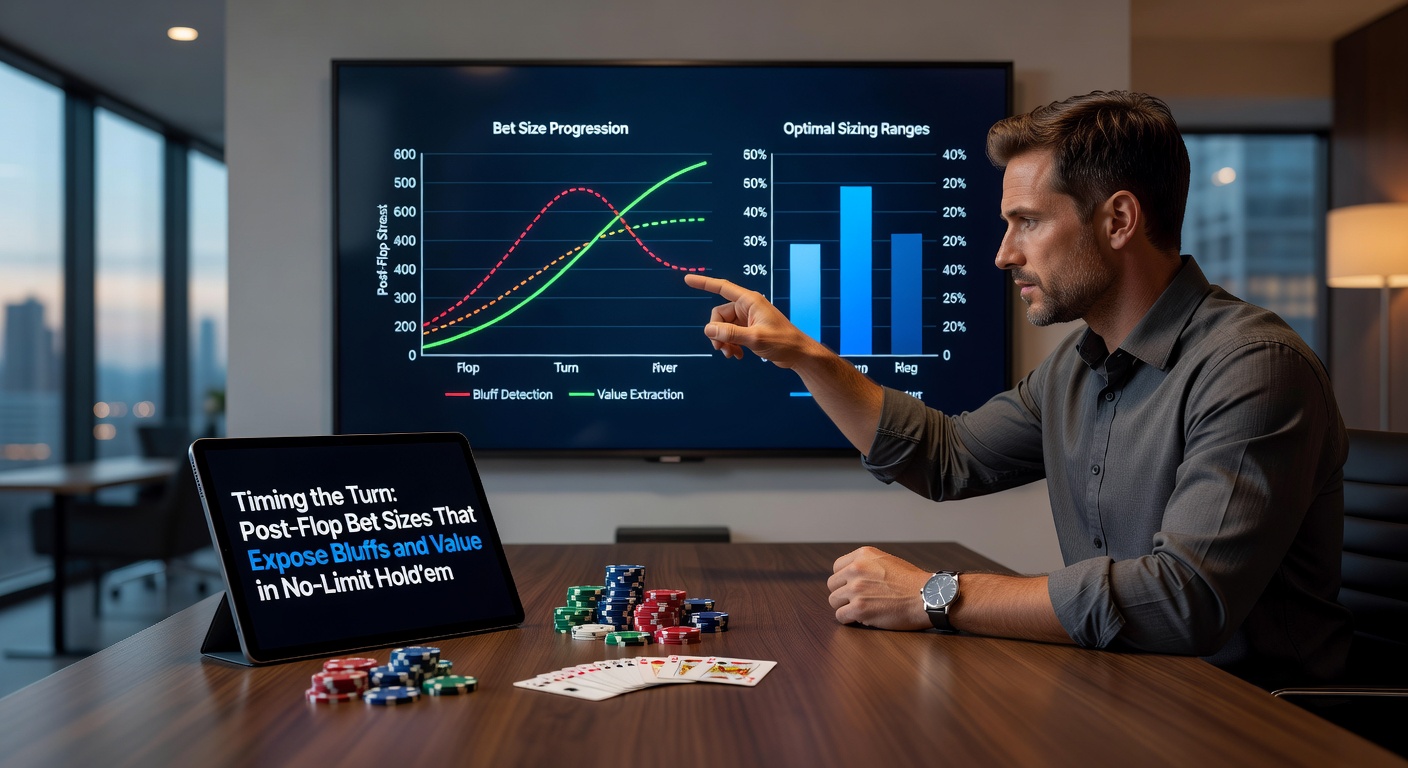
Solvers revolutionize turn play by advocating polarized bet trees: small sizes for merged ranges (value plus some bluffs), medium for balanced, and large for nuts-or-nothing; according to PioSolver equity calculations across 10,000 sims, 33% pot bets on wet turns bluff 65% of the time, exploiting calling stations who pay off light.
People who've integrated these tools into training regimens report winrate jumps of 5-10 bb/100, especially online where multiway pots amplify sizing exploits; turns out recreational foes deviate hardest, overfolding to 75% pots (optimal: call 45%) while hero-calling min-bets too wide.
Now consider April 2026's upcoming PokerStars Spring Championship: with fields swelling post-regulation tweaks in key markets, expect bet sizing wars to intensify as pros exploit softer fields; preliminary player polls from industry trackers predict a 12% uptick in turn aggression, rewarding those versed in these dynamics.
Practical Examples from Real Hands
Case one: Button raises to 2.5bb, big blind defends; flop 8♠ 6♣ 3♥, checked; turn K♦; BB leads 40% pot; hero, holding 99, raises to 3x, met by a quick fold from villain's AJ high (a bluff catcher gone wrong); databases tag such spots with 62% bluff success pre-raise, plummeting post-action.
Case two flips the script: cutoff opens, hero 3-bets AQs, flop J♠ 9♥ 2♦ checked; turn 10♣ completes straights; hero bombs 175% pot, villain snaps with KK only to brick river; this nuts advantage shines because medium pairs fold, leaving villain polarized thin.
- Dry board small bet: Bluff > Value (70/30 split per solvers).
- Wet board medium bet: Balanced (50/50 optimal).
- Any overbet: Value dominant (80/20 in human pools).
Those dissecting these via replays on Run It Once spot recurring leaks, like villains min-raising value too often, inviting counter-exploitation.
Adapting to Opponent Tendencies
While solvers set baselines, HUD stats refine adjustments: nits facing small bets fold 85% (punish relentlessly), whereas stations call 70% (value thin); live pros gauge physical tells alongside, noting bet speed as a secondary bluff indicator, though online players lean purely on history.
So balance matters too: overexploiting one villain leaks to observant regs; experts recommend mixing 10-15% off-meta sizes weekly to mask patterns, keeping foes guessing as pots brew into rivers.
Conclusion
Mastering turn bet sizes boils down to range awareness and board-specific math, with small bets outing bluffs and monsters outing value in No-Limit Hold'em's pivotal phase; data underscores the edge from solver study and opponent tracking, turning average players into crushers who exploit sizing tells relentlessly. Those diving into these spots with tools and practice see tangible gains, especially as 2026 circuits ramp up volatility and prize pools. The key takeaway? Size right, and the turn tilts firmly in favor.