Layered Probability Trees for Mapping Optimal Plays in Three-Card Poker
Written by Cameron Lehmann · Jul 19, 2026
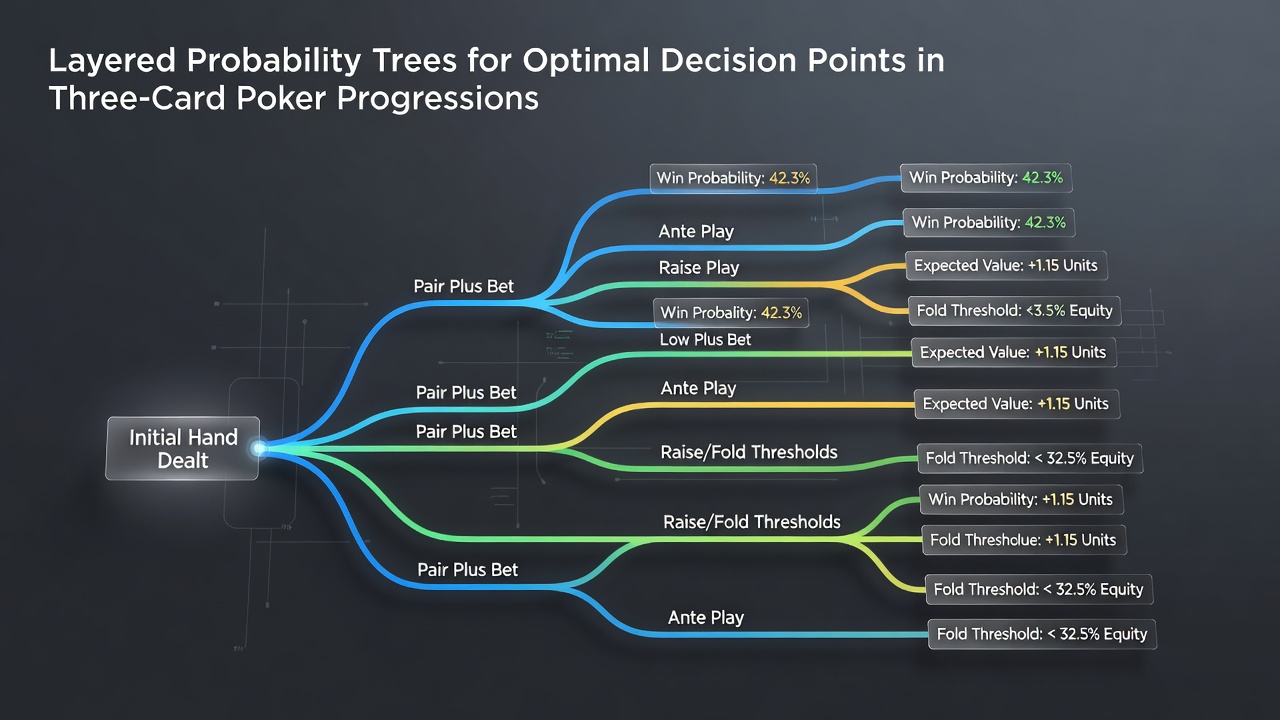
Layered Probability Trees for Mapping Optimal Plays in Three-Card Poker
Three-card poker relies on straightforward hand rankings yet demands precise decisions at multiple betting stages where players choose between folding and raising after receiving their cards. Layered probability trees organize these choices into successive levels that account for initial card distributions, subsequent opponent ranges, and payout structures across ante, play, and pair plus wagers.
Core Structure of Three-Card Poker Decisions
Dealers distribute three cards to each participant from a standard 52-card deck while players place an ante to begin. After viewing their holdings individuals decide whether to fold and forfeit the ante or to raise with an additional play bet equal to the ante. A dealer then reveals three cards and qualifies with queen-high or better; non-qualifying hands return the ante while play bets push. Qualifying dealer hands trigger comparisons that pay 1:1 on winning play bets and return the ante, whereas losses surrender both wagers. Pair plus side bets pay according to fixed tables for pairs, flushes, straights, three-of-a-kind, and straight flushes regardless of dealer qualification.
Building Layered Probability Trees
Analysts construct base layers by enumerating all possible three-card combinations and their frequencies, which total 22,100 distinct hands when order is ignored. Subsequent layers incorporate conditional probabilities for dealer qualification and player outcomes given specific raise thresholds. Advanced models add branches for pair plus payout variations and for multi-hand sessions where prior results influence bankroll allocation yet leave individual hand probabilities unchanged. Data from exhaustive enumeration shows that optimal play raises with queen-six-four or better while folding weaker holdings, a threshold that reduces the house edge on the ante-play combination to approximately 3.37 percent according to mathematical reviews published by the University of Nevada, Reno gaming laboratories.
Application to Progressive Decision Sequences
Layered trees extend beyond single-hand analysis by sequencing decisions across repeated rounds where bet sizing may adjust based on accumulated results. One branch tracks the probability of reaching a qualifying dealer hand after a player raise, while parallel branches calculate expected values for pair plus triggers such as three-of-a-kind combinations that occur once every 425 hands on average. Researchers at the Australian Gambling Research Centre have published combinatorial studies that demonstrate how stacking these layers reveals optimal thresholds for increasing or decreasing pair plus participation during extended play sequences without altering the underlying house edge.
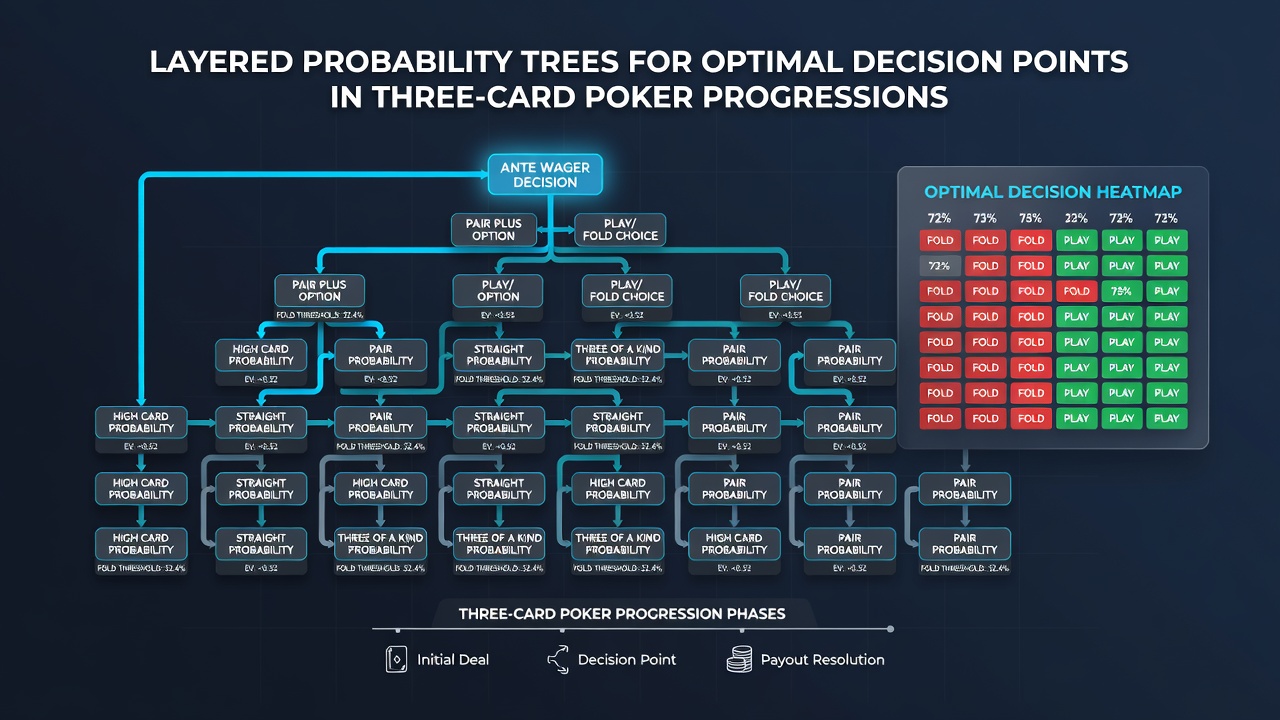
Transitions between layers rely on Bayes updates that refine remaining deck composition after each revealed card, although three-card poker deals occur from a fresh shuffle each round. The method therefore functions primarily as a visualization tool that clarifies expected-value calculations rather than as a counting system. Industry reports from the European Casino Association note that operators increasingly employ such tree-based analytics to calibrate table minimums and promotional structures that align with observed player behavior patterns.
Quantifying Edges Across Bet Types
Separate layers isolate the ante-play wager from the pair plus side bet, revealing distinct house advantages. The ante-play combination carries a 3.37 percent edge under optimal strategy while pair plus carries 2.32 percent when using standard paytables that award 40:1 for straight flushes. Adjusting paytables to lower straight flush returns to 30:1 increases that edge above 4 percent, a shift that layered models quantify by recalculating terminal nodes for each payout modification. Observers note that these recalibrations help operators maintain consistent hold percentages even as player preferences shift toward or away from side wagers.
Integration with Regulatory Updates in July 2026
Beginning in July 2026 several North American jurisdictions plan to require operators to publish updated game mathematics for all table games including three-card poker variants. Layered probability trees supply the documentation framework that satisfies these disclosure rules by presenting decision thresholds and expected values in transparent, auditable formats. Gaming control boards in Nevada and New Jersey have signaled acceptance of tree-based submissions provided they include exhaustive enumeration of all 22,100 hands and verification of dealer qualification probabilities that equal 0.6924 under random distribution.
Conclusion
Layered probability trees supply a systematic method for dissecting decision points in three-card poker by organizing combinatorial data into successive conditional branches. The approach yields precise expected-value figures for ante, play, and pair plus wagers while accommodating sequence-level analysis across multiple rounds. Regulatory developments scheduled for July 2026 are expected to increase reliance on such models for compliance documentation, and academic sources continue to refine the underlying enumerations that support them.