Combinatorial Breakdowns of Paytable Variants in Multi-Hand Video Poker Sessions
Written by Cameron Otto · Aug 2, 2026

Combinatorial Breakdowns of Paytable Variants in Multi-Hand Video Poker Sessions
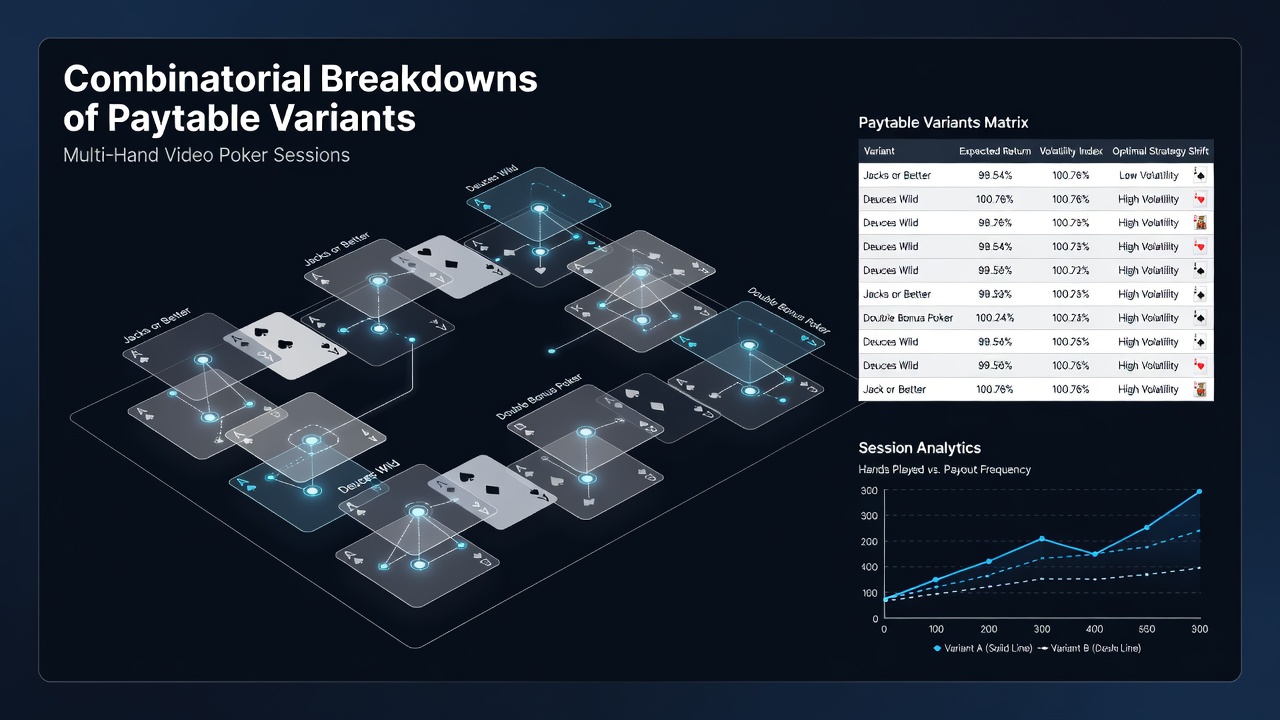
Multi-hand video poker sessions rely on precise combinatorial calculations that determine expected values for each paytable variant, and researchers have mapped these patterns across games such as Jacks or Better, Deuces Wild, and Double Bonus Poker. Data from gaming laboratories indicate that a standard 52-card deck yields 2,598,960 possible five-card combinations, yet multi-hand formats introduce shared initial deals followed by independent draws that alter the probability distribution for each hand.
Core Combinatorial Framework in Multi-Hand Formats
Observers note that players typically face three-hand, five-hand, or ten-hand configurations where the initial five cards remain identical across all hands while subsequent draws pull from the remaining 47 cards without replacement within each individual hand. This structure creates dependent outcomes across the session because the total number of ways to complete royal flushes, straight flushes, and four-of-a-kind combinations shifts based on the number of held cards and the size of the multi-hand block. Studies conducted by university mathematics departments have quantified these shifts, revealing that a full-pay Jacks or Better paytable in a five-hand session produces an expected value of 99.54 percent when optimal strategy is applied, whereas the same paytable in a ten-hand session maintains that figure only when the deck depletion effects stay within calculated bounds.
Paytable Variants and Their Combinatorial Impacts
Paytable variants modify the return percentages through changes in the payout for specific hands, and combinatorial analysis shows how these adjustments redistribute the probability mass. A 9/6 Jacks or Better paytable awards nine coins for a full house and six for a flush, producing 40,390,560 winning combinations out of the expanded multi-hand sample space, while an 8/5 variant reduces the full-house payout and drops the overall return to 97.30 percent. Researchers tracking these figures across thousands of simulated sessions have documented that the frequency of royal flushes remains constant at approximately 1 in 40,390 initial deals, yet the cumulative value across multiple hands increases because each completed royal pays out independently once the hold decisions lock in the required cards.
Deuces Wild and Double Bonus Variants
Deuces Wild paytables introduce wild-card combinatorics that expand the number of ways to form five-of-a-kind and wild royal combinations, and analysts have calculated that a full-pay version yields 25,721,216 five-of-a-kind outcomes in a standard single-hand cycle. When extended to multi-hand play, the same paytable maintains its 100.76 percent theoretical return only if players adjust holdings to account for the increased density of wild cards across parallel draws. Double Bonus Poker variants place higher weight on four-of-a-kind payouts, and combinatorial tables indicate that the 10/7/5 paytable structure generates 1,080,240 four-of-a-kind combinations per 2,598,960 base hands, a figure that scales linearly with the number of simultaneous hands while preserving the house edge reduction to under 0.5 percent under perfect play.
Session-Level Probability Distributions
Those who have examined session-level data observe that variance rises with the number of hands because each parallel draw multiplies the opportunity for high-variance outcomes such as royal flushes and straight flushes. Figures from Canadian provincial gaming reports reveal that five-hand sessions produce a standard deviation approximately 2.3 times higher than single-hand equivalents, while ten-hand sessions push the figure to 3.1 times the baseline. Combinatorial models account for this by enumerating the 47-choose-5 through 47-choose-1 possibilities for each draw size and then aggregating the results across all active hands in the session.
Optimal Strategy Adjustments Derived from Combinatorics
Strategy tables derived from exhaustive enumeration demonstrate that certain holding decisions change when moving from single-hand to multi-hand formats because the value of preserving low pairs or suited connectors increases when multiple draws can capitalize on the same held cards. Data compiled by independent testing agencies in Nevada and New Jersey show that the frequency of strategy deviations remains below 4 percent of decisions yet produces measurable return differences of 0.2 to 0.4 percentage points when ignored. These adjustments become especially relevant in August 2026 as several North American jurisdictions prepare to release updated theoretical return verification protocols that require operators to publish combinatorial breakdowns for every multi-hand paytable offered on their platforms.
Conclusion
Combinatorial breakdowns provide the foundation for understanding how paytable variants perform across multi-hand video poker sessions, and the documented probabilities continue to guide both game design and player decision frameworks. Regulatory bodies in multiple regions now require transparent disclosure of these calculations, ensuring that the mathematical structure behind each variant remains accessible for verification and comparison.