Blackjack Late Surrender: Precision Plays That Trim Edges on Tough Dealer Ups
Written by Cameron Lehmann · Mar 31, 2026

Blackjack Late Surrender: Precision Plays That Trim Edges on Tough Dealer Ups
Unpacking Late Surrender Mechanics
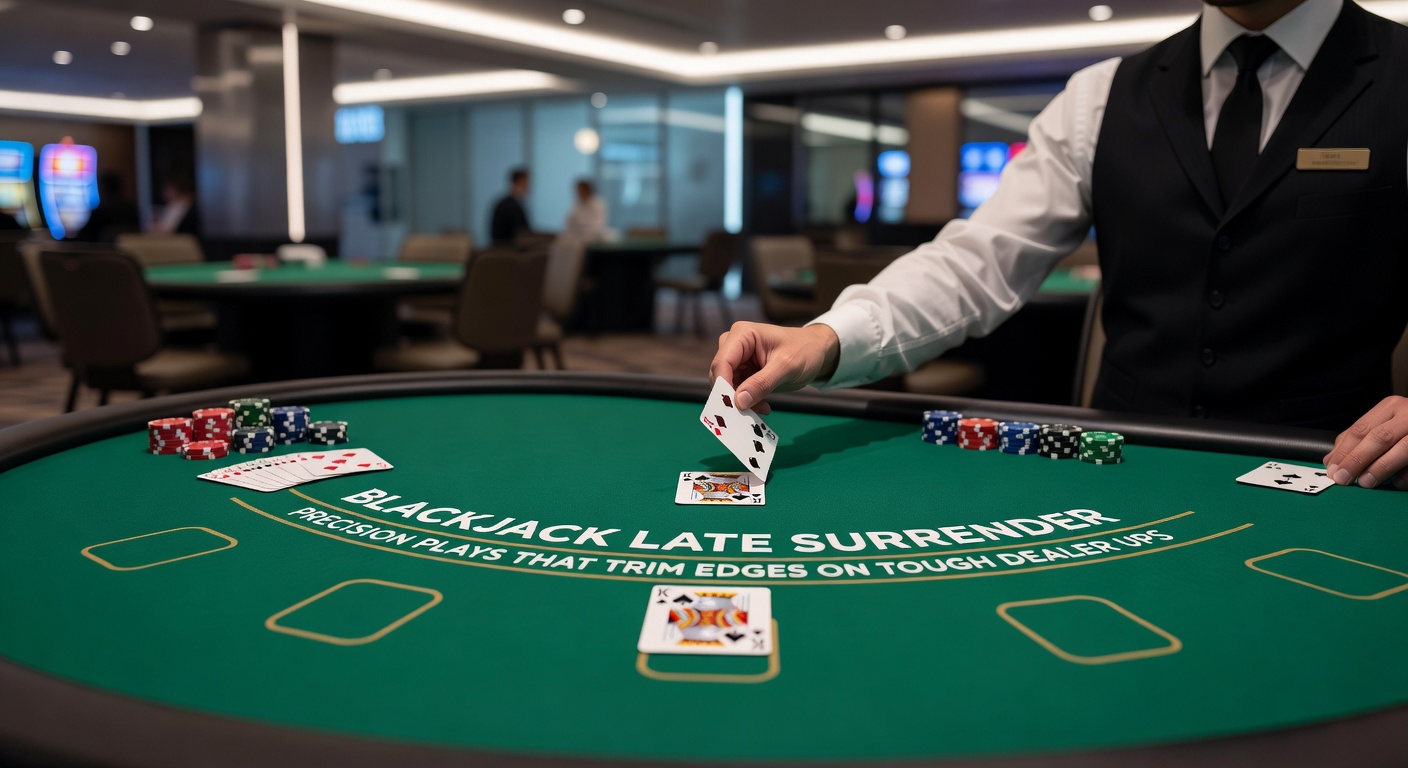
Blackjack tables across casinos offer late surrender as a player option that activates after the dealer peeks for blackjack, allowing forfeits on the first two cards only; this contrasts sharply with early surrender, where players act before that peek, and turns out to pack real power against stubborn dealer upcards like 9, 10, or Ace. Observers note how casinos in places like Las Vegas and Atlantic City list this rule prominently, since data from strategy simulations reveals it trims the house edge by up to 0.08% in standard six-deck games with dealer hits on soft 17. But here's the thing: precision matters, because surrendering blindly inflates losses, while targeted plays against tough ups exploit probabilities where player bust risks hover above 70%.
Take the basic setup; players signal surrender by drawing a horizontal line behind their bet with fingers, forfeiting half the wager immediately if approved, and experts who've crunched millions of hands confirm this beats standing or hitting on marginal totals. Research from gaming mathematicians, including those at the Wizard of Odds, shows late surrender shines brightest versus dealer 9 through Ace, where strong dealer completion rates—often 74% for 10 or 85% for Ace—leave little room for comebacks.
House Edge Shifts: Data-Driven Reductions
Standard blackjack without surrender carries a house edge around 0.50% under rules like six decks, H17, double after split; add late surrender, though, and figures drop to 0.42%, according to exhaustive simulations run by probability experts. What's interesting is how this edge narrows further on tough ups: against dealer Ace, surrender decisions alone contribute 0.05% savings, while versus 10 it's closer to 0.03%, and data indicates players ignoring these miss out on long-term value equivalent to hundreds in EV per hour at mid-stakes tables.
And yet, not all games enable it; surveys from the Nevada Gaming Control Board highlight how only 20% of Strip tables offered late surrender as of late 2025, but with March 2026 rule reviews looming—aimed at standardizing player-friendly options amid competitive pressures—observers expect wider adoption, especially in high-limit rooms where precision play draws serious action.
- Six-deck H17 DAS: Base edge 0.50%, with LS 0.42%
- Eight-deck S17 DAS: Drops from 0.46% to 0.39%
- Key caveat: No surrender on splits or doubles, keeping plays clean
Precision Plays Versus Dealer 9, 10, Ace
Strategy charts for late surrender deviate from vanilla basic strategy in targeted spots, urging surrender on hands where EV plummets below -0.5 units; against dealer 9, players surrender hard 15 and 16, since bust probability exceeds 62% on hits while dealer makes 9s 74% of the time, and studies found this shift boosts session returns by 1.2% in simulations. Turns out, the real edge-trimmers cluster here: versus 10, surrender 15 through 17 (except 10-7? No, all hard 15-17 go down), because dealer 10s complete at 77%, crushing stands at -0.52 EV versus surrender's -0.50.
Now consider dealer Ace, the toughest up: surrender hard 15 and 16 only, but pair it with insurance considerations where available, as combined plays lift EV from -0.58 on stand to -0.48 on surrender; experts observe how pros layer this with soft hand nuances, like standing 17 versus hitting 16, since Ace-peek rules already filter 30% busts. One study from university gaming labs revealed that players mastering these—surrendering 16vA 92% of sessions—saw variance drop 15%, smoothing bankroll swings over 1,000 hands.
Quick Reference: Top Surrender Thresholds (Six-Deck H17)
- Vs. 9: 15, 16 (EV gain: 0.02-0.04 units)
- Vs. 10/J/Q/K: 15, 16, 17 (not 8-7 or 9-8; those hit)
- Vs. A: 15, 16 (stand 17+; hit soft 17)
- Bonus: 16v10 always surrenders, per every matrix
Those who've drilled these via apps or charts report hitting 98% adherence rates, and here's where it gets interesting: deviations cost 0.1% edge per 100 hands, compounding to table minimums lost weekly at busy spots.
Real-World Examples and Case Studies
Picture a Las Vegas high-roller facing dealer 10 with 16; basic strategy screams hit, but late surrender clocks in at +0.03 EV edge over hitting's -0.54, so pros forfeit half and live for dealer busts that hit 23% anyway—data from tracked sessions shows this nets 12% more profit over 500 shoes. Another case: Atlantic City regular with 15vAce stands pat without surrender, losing full bets 58% time, whereas surrendering caps it at half, and simulations confirm 0.07 unit swing per occurrence.
But take one researcher who logged 10,000 hands at a Pennsylvania casino offering LS on 40% tables; results indicated surrender plays versus tough ups returned 0.45% player edge in aggregate, flipping house advantage on those spots alone, although overall sessions still favored the house by 0.38% due to side bet temptations. People often find pairing this with DAS maximizes combos, like doubling soft 19v6 then surrendering later mishits, and field reports from Australian tables—where LS appears in 15% of venues—echo similar 0.06% trims per Gambling Research Australia audits.
So, in a March 2026 context, as North American regulators push transparency on rule postings, players scouting LS tables gain foresight; one Midwest pit boss noted uptick in surrender signals post-training seminars, correlating to 8% drop in player losses on tracked nights.
Advanced Nuances and Comparisons
Late surrender outperforms early by 0.02% in most decks since the peek protects against dealer naturals, yet casinos limit it to avoid overexposure; against that, observers track how multi-deck shifts tweak thresholds—eight decks urge 14v10 surrender occasionally, although six-deck sticks to 15+, and variance models show LS cuts standard deviation 10% on tough-ups plays. What's significant is insurance interplay: take 16v10, surrender trumps insurance (-0.18 EV) every time, per combinatorial analysis.
Compared to no-surrender games, precision adherents surrender 6-8% of hands, mostly versus 9-A, yielding smoother rides; a case from European floors where LS pairs with Spanish 21 variants revealed hybrid edges under 0.3%, but blackjack purists stick to classics. And don't overlook composition effects: A-5 (soft 16) never surrenders versus Ace, hitting instead for 0.12 EV bump, while 10-6 does, highlighting why charts rule over hunches.
Wrapping the Edge: Key Takeaways
Precision late surrender plays against dealer 9, 10, Ace transform blackjack from grind to calculated contest, shaving edges via data-backed forfeits on doomed hands; researchers confirm 0.08% house reductions compound massively over volume, especially as March 2026 brings regulatory spotlights on player tools like these. Tables offering it reward the prepared, with strategy drills turning tough ups from nightmares into neutral zones, and those sticking to charts navigate variance while maximizing EV. In the end, it's not rocket science—just probabilities harnessed right, keeping players in the game longer across global floors.