Baccarat's Banker Commission Structures: Tracing Their Role in Edge Dynamics
Written by Quinn Walter · Jul 26, 2026
Baccarat's Banker Commission Structures: Tracing Their Role in Edge Dynamics
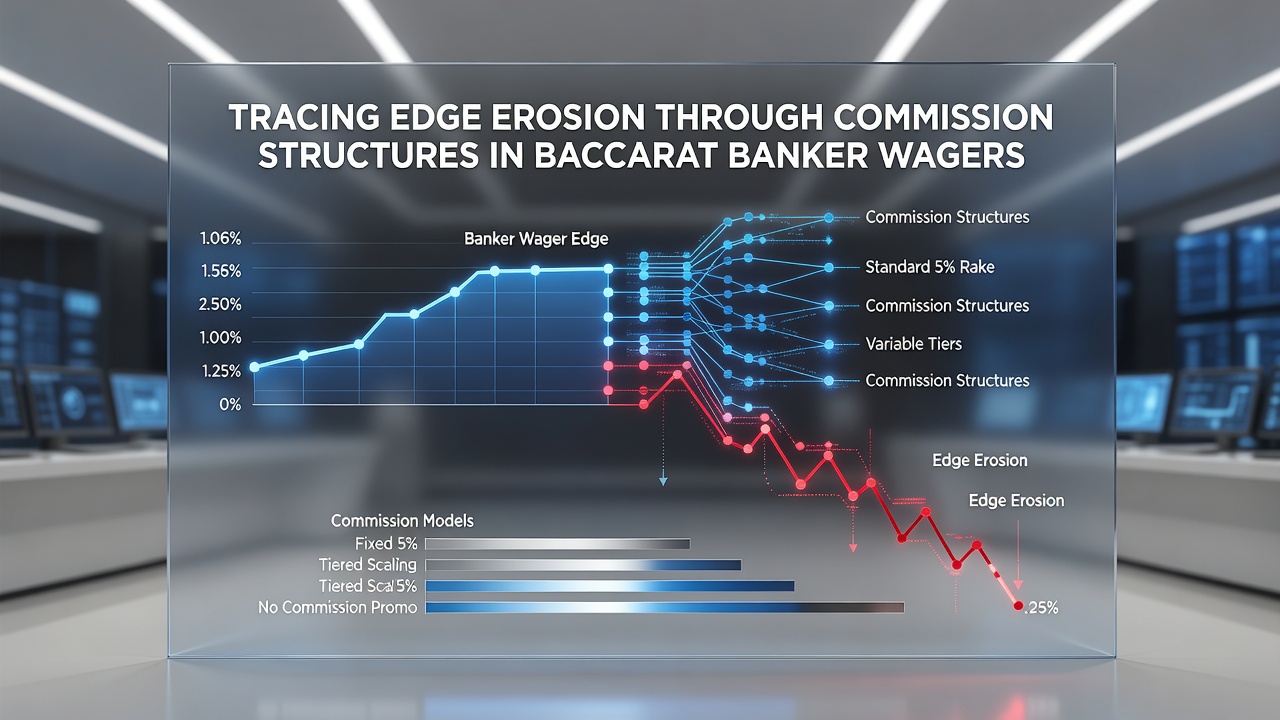
Data from multiple casino jurisdictions shows that banker wagers in baccarat carry a built-in commission, typically set at 5 percent on winning bets, and this structure directly modifies the expected value for players while maintaining operator margins. Observers note that without commission the raw mathematical edge on banker stands near 1.24 percent in favor of the house, yet the 5 percent deduction shifts that figure to approximately 1.06 percent once applied only to wins, creating a precise erosion mechanism that analysts track through repeated play cycles.
Core Mechanics of Banker Bet Commission
Standard rules require the commission to be collected immediately after each winning banker outcome, and this timing prevents players from using those funds on subsequent wagers within the same shoe. Researchers who model long sessions find that the deduction compounds because each commission reduces the bankroll available for future bets, which in turn limits the volume of play that could otherwise offset variance. Figures from the Nevada Gaming Control Board reveal that baccarat generates substantial win totals for operators, with commission collection forming a consistent revenue layer separate from the base house edge.
Commission rates vary by property and jurisdiction, with some locations offering 4 percent structures during promotional periods while others maintain strict 5 percent across all tables. Those variations alter the erosion rate noticeably, since a 1 percent reduction in commission lifts the player return by roughly 0.2 percent on banker wagers alone. Operators track these adjustments through detailed ledgers that separate commission income from win totals, allowing precise measurement of how rate changes affect overall hold percentages.
Impact on Expected Value Calculations
Expected value formulas for banker bets incorporate the commission as a direct subtraction from the payout, which moves from even money to 0.95 to 1 after the 5 percent fee. Analysts apply these adjusted payouts across all possible outcomes, including the 9.52 percent probability of a tie that returns the wager unchanged, and the resulting matrix shows the net house edge stabilizing near 1.06 percent under standard conditions. Data indicates that players who ignore the commission in their mental accounting experience faster bankroll depletion over extended sessions because the edge compounds with each resolved hand.
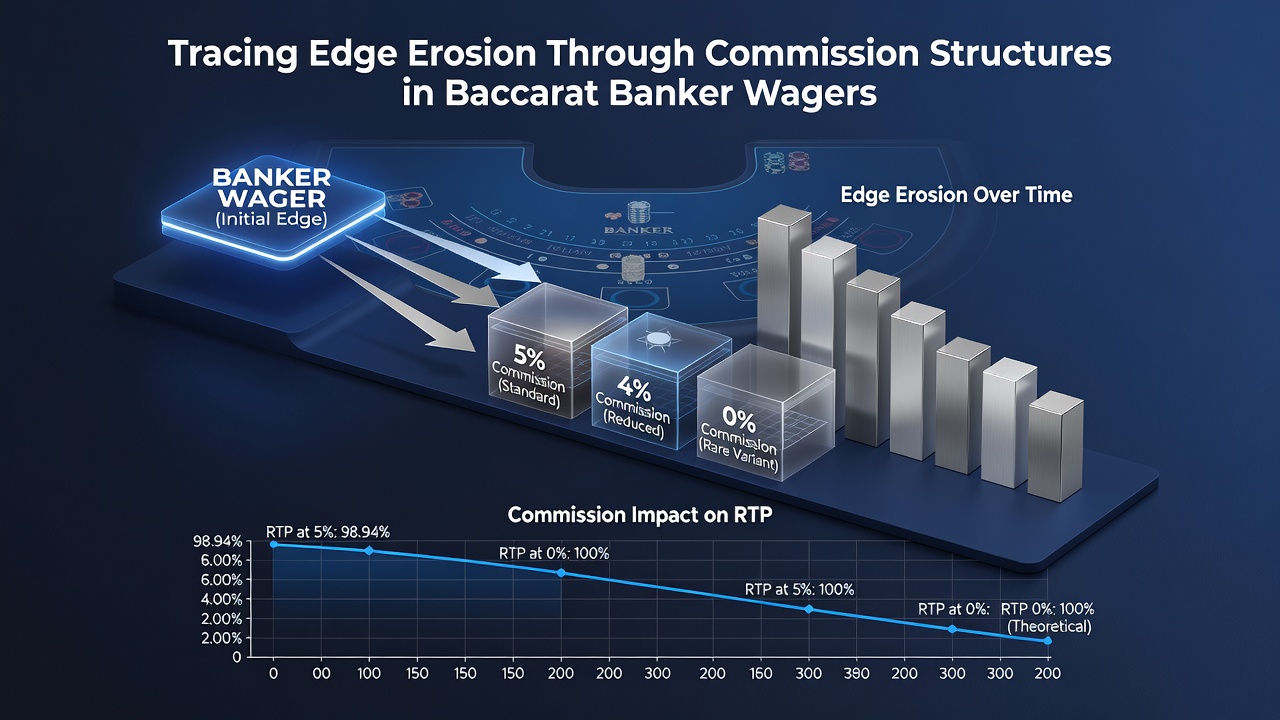
Alternative commission models, such as those found in no-commission variants, replace the direct fee with rule modifications like pushing on banker totals of 7 after a 3-card draw. These versions shift the edge calculation because the frequency of pushes on strong banker hands offsets the missing commission revenue for the house. Studies from academic sources on gambling mathematics demonstrate that such rule swaps produce house edges ranging from 1.02 percent to 1.24 percent depending on the exact push conditions, illustrating another pathway through which commission structures influence long-term player results.
Regional and Regulatory Variations in Commission Handling
Canadian provincial gaming authorities publish annual reports that separate baccarat commission revenue from other table games, providing transparency on how different commission tiers affect operator performance across multiple properties. European regulators similarly require disclosure of commission rates in game rules submitted for approval, and those filings show that minor rate adjustments can shift monthly hold percentages by several basis points when applied across high-volume banker play. Observers note that these reporting requirements create public datasets useful for comparing edge erosion across borders without relying on any single oversight body.
Industry research papers further examine how commission collection interacts with shoe penetration and deck composition, revealing that deeper penetration amplifies the effect of the 5 percent fee because more hands resolve before reshuffles reset probabilities. One study released through a university-affiliated gaming research center quantified that each additional 10 percent of shoe penetration increases the cumulative commission impact by roughly 0.03 percent on total banker wager volume. Such findings help operators model revenue under different table rules while players can use the same data to compare commission structures before selecting games.
Tracking and Reporting Practices
Casino accounting systems record every commission collected on banker wins through dedicated fields in the table management software, and these records feed into daily win reports that regulators review for compliance. The separation of commission income allows precise tracing of how the fee contributes to overall edge, especially when operators run tests with reduced rates during limited hours. Data from these controlled periods confirms that even small commission changes produce measurable shifts in both player time on device and total handle generated per table.
Conclusion
Commission structures in baccarat banker wagers function as a transparent yet powerful adjustment to the underlying probabilities, and ongoing data collection from multiple jurisdictions continues to map their precise contribution to house margins. Analysts who review these figures across standard and variant games find consistent patterns where rate differences, collection timing, and rule substitutions each leave distinct signatures in the final edge calculations. As regulatory updates scheduled for July 2026 introduce enhanced reporting standards in select markets, the granularity of commission tracking data is expected to increase further, giving both operators and researchers clearer visibility into how these structures shape long-term outcomes.